Dental Implant Insurance Explained: What’s Covered And What’s Not
Most dental plans pay toward part of an implant, but the annual maximum usually decides the bill. Here is how plans treat each part of implant treatment, when medical insurance helps, what usually isn’t covered, and what to ask your carrier before you schedule.

Quick answer: Most dental plans pay toward part of a dental implant, usually as a major service at a set percentage after your deductible. The real limit is the annual maximum, which often caps the plan’s yearly payment below the cost of one implant. Medical insurance helps only in specific, documented situations, and your carrier decides.
The letter from your dentist says you need an implant for the tooth you lost last spring.
So you do the sensible thing. You open your benefits booklet, find the line that says “Major services: 50%,” and do the math in your head.
Half of an implant. That feels manageable.
Then you notice a second line further down the page. Annual maximum: $1,500.
That second number is the one that decides your bill.
The simple answer is that yes, many dental plans now pay toward implants.
The more honest answer is that what your plan “covers” and what it actually pays are two different numbers. The gap between them is where most of the surprises live, so let’s walk through it line by line.
Does dental insurance cover dental implants?
Often, yes, at least in part. Many employer plans list implants under major services, next to crowns, bridges and dentures.
Penn State’s employee dental plan is a typical example. Implants sit in its Class III Major Services category, and each covered member has a $1,500 annual program maximum (Penn State Human Resources, n.d.).
That structure is common. A percentage applies to each procedure, and a yearly ceiling applies to everything combined.
Elite Oral Surgery’s insurance and coverage page lists single implants among the procedures dental plans typically cover at 50 to 80%. It also notes that the crown may carry separate limits, and that real coverage depends on your policy, deductible, waiting periods and pre-authorization rules.
Typical is not guaranteed. Your plan document is the only thing that settles it.
What parts of a dental implant does insurance pay for?
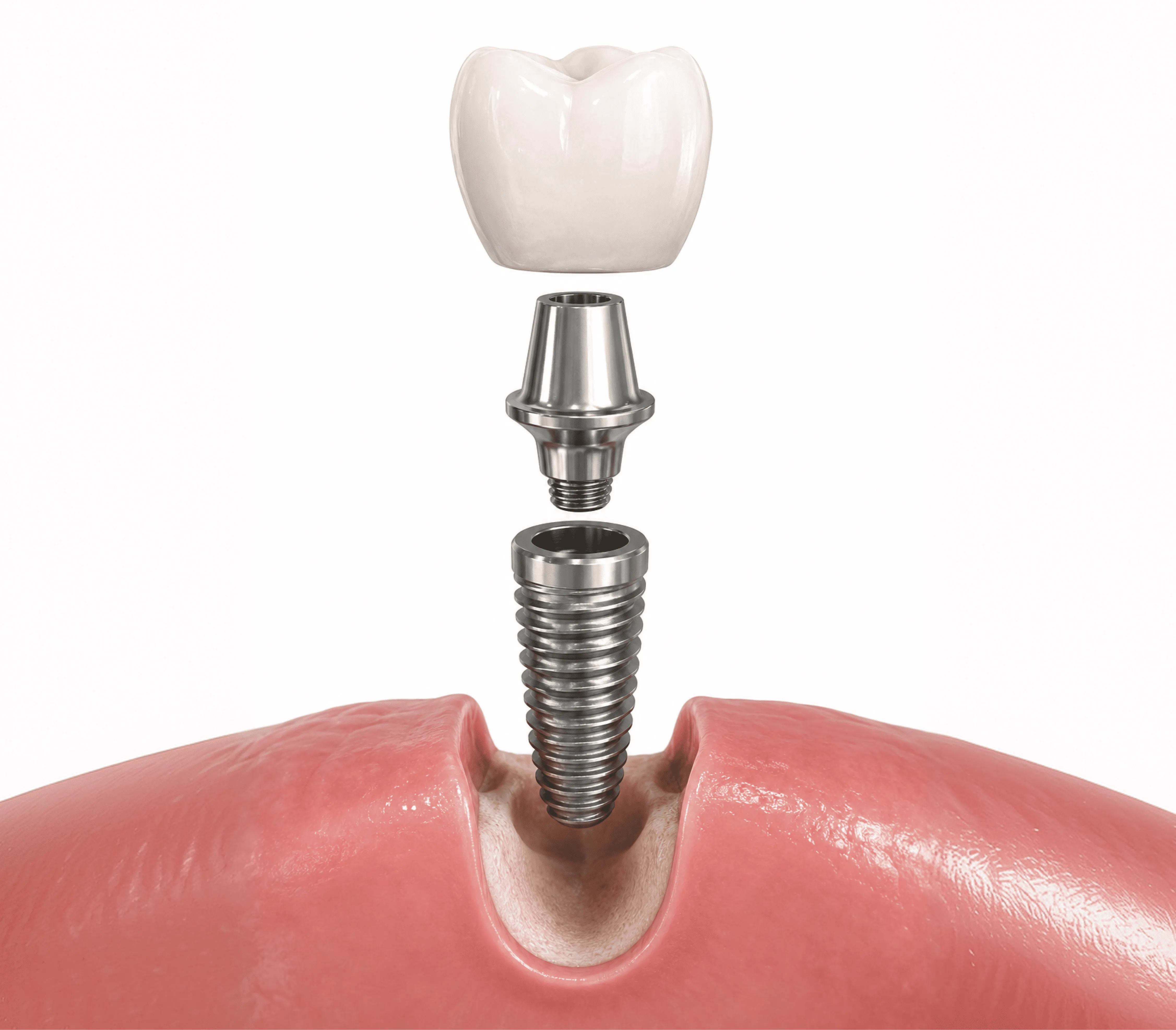
An implant isn’t billed as one item. It’s several line items, and your plan can treat each one differently.
At Elite, the surgical side (the implant fixture, its placement and standard imaging) is quoted separately from the final crown, which your general dentist places. Bone grafting and IV sedation are added only when your case needs them, as the single dental implants page lays out.
Ranges come from Elite Oral Surgery’s published insurance and single-implant pages. They are typical, not guaranteed. Your plan document decides.
The pattern to notice: the parts that vary most from plan to plan are the ones that depend on your anatomy, like grafting and a sinus lift.
The Biggest Difference: Your Annual Maximum, Not Your Percentage
Most people read the percentage first. The maximum matters more.
The percentage tells you the plan’s share of each procedure. The annual maximum tells you the most the plan will pay in the plan year, for everything combined, including cleanings, fillings, crowns and the implant.
Here’s an illustration, not a quote. Say your plan pays 50% of major services and has a $1,500 annual maximum, like the Penn State example. Elite’s published range for a complete single implant in the South Sound is $3,500 to $6,000.
Half of even the low end is $1,750. That’s already past a $1,500 ceiling, before counting any fillings or cleanings you had earlier in the year.
The percentage is the plan’s share. The maximum is where the plan stops paying.
This is why two people with “the same coverage” can get very different bills. One hasn’t used any benefits yet this year. The other had a crown in March.
For full-arch treatment, the gap is wider still. Elite’s insurance page puts dental plan contributions for full-arch work at roughly $1,000 to $3,000, a small fraction of the case. That’s one reason the practice publishes a single all-inclusive full-arch price of $15,000 per arch, the same whether or not you have insurance.
Does medical insurance ever cover dental implants?
Sometimes, but only in specific circumstances.
Elite’s insurance page lists situations that may qualify: severe periodontal disease with documented bone loss, traumatic injury, congenital conditions, reconstruction after cancer treatment, and chronic conditions that affect nutrition and health.
It’s also clear about who decides. In the page’s words: “We don’t make the medical-necessity determination, your carrier does.”
In practice that means documentation: medical records, imaging and often pre-authorization.
If you’re on Medicare, plan for dental costs separately. Medicare was built around physical health needs rather than oral health, which leaves many older adults paying for dental care on their own (Willink et al., 2016) (Johns Hopkins, 2016). Check whether any dental benefits come with your specific plan before you assume either way.
What does dental insurance usually not cover for implants?
The exclusions are rarely dramatic. They’re usually quiet limits that add up.
- Anything above the annual maximum. Once the plan hits its ceiling, the rest is yours until the plan year resets.
- Bone grafting on some plans. Elite’s insurance page notes that some plans exclude grafting and sinus lifts outright.
- Treatment during a waiting period. Waiting periods are one of the factors the practice lists as changing what a plan will actually pay.
- Sedation, in part. IV sedation is often only partially covered.
- A tooth lost before your coverage began, on some plans. Ask your carrier directly whether your plan has a “missing tooth” provision, and get the answer in writing.
None of these are reasons to skip treatment. They’re reasons to ask before you schedule, not after.
What should I ask my insurance company before getting an implant?
A ten-minute call to your carrier can save you a surprise later. Have your member ID ready and ask:
- Are dental implants covered on my plan, and under which service category?
- What is my annual maximum, and how much of it is left this plan year?
- When does my plan year reset?
- Is there a waiting period for major services, and have I already met it?
- Are bone grafts, sinus lifts and IV sedation covered, and do any of them need pre-authorization?
- Does my plan limit replacing a tooth that was missing before my coverage started?
- Can you issue a predetermination once I have a treatment plan?
Write down the date, the name of the person you spoke with, and what they said. If the answers don’t match what you were told later, that note matters.
You don’t have to do this alone, either. Elite verifies benefits for free, online in one to three business days or by phone, and turns the answers into a written estimate.
Is an implant still worth it if insurance pays very little?
That depends on what you compare it with.
A bridge often looks cheaper on day one. Elite’s single implant page estimates a bridge at about $1,000 to $1,500 less upfront, but puts 30-year costs at $6,000–$8,000 for the implant path and $10,000–$18,000 for the bridge path.
Published modeling points the same way. A 20-year cost-effectiveness model for one missing tooth found an implant-first strategy was the dominant option, with lower overall costs and a higher success rate than a bridge-first strategy (Bouchard et al., 2009).
The survival numbers explain part of that. A large systematic review estimated 10-year survival of 89.2% for conventional tooth-supported bridges and 89.4% for implant-supported single crowns. The bridges’ most frequent problems were biological, like decay and loss of nerve vitality in the supporting teeth (Pjetursson et al., 2007).
The implant itself tends to last. A 2019 systematic review estimated 10-year implant survival at 96.4% (Howe et al., 2019).
Insurance pays for a procedure. It doesn’t pay for the healthy teeth a bridge has to lean on.
And if cost is the thing holding you back, you’re far from alone. Cost is the most common barrier to needed dental care for working-age adults, including those with private dental insurance (Vujicic et al., 2016).
What We Look at Before Recommending Treatment Around Your Insurance
Insurance shouldn’t decide your treatment. It should shape how the treatment is planned and paid for.
Your imaging, first. A 3D scan shows whether you’ll need a bone graft or sinus lift, which are the line items plans treat most unevenly. Timing matters here. After an extraction, the ridge loses roughly 29–63% of its width and 11–22% of its height within six months (Tan et al., 2012).

Your plan year. Maximums reset each plan year, and a single implant takes about four to six months from start to finish. Surgery and the final crown sometimes fall in different plan years naturally. If the clinical timing allows it, that’s worth knowing in advance.
A predetermination. Many carriers will issue a pre-treatment estimate for expensive procedures. It gives you an idea of what you’ll pay, but it isn’t a guarantee of payment (University of Virginia Human Resources, n.d.).
Your other money. Elite lists HSA and FSA funds as eligible for implant treatment and provides the documentation and procedure coding for reimbursement. Financing can cover what’s left.
What are the limits of relying on insurance?
- Estimates aren’t promises. A predetermination is an estimate, and final payment is decided when the claim is processed (University of Virginia Human Resources, n.d.).
- Medical coverage is the carrier’s call. A surgeon can document a case, but the carrier makes the medical-necessity decision.
- Benefits shouldn’t set the surgical schedule. Waiting too long after an extraction can mean more bone loss and a bigger graft (Tan et al., 2012).
- Claims can’t be filed yet. Elite opens in April 2027, so verification today is planning, not billing.
How much does a dental implant cost with insurance in Bonney Lake?
For patients in Bonney Lake and across Pierce and King counties, Elite publishes its pricing before you schedule:
- Surgical placement: $2,200–$2,800 per implant
- Bone grafting, when needed: add $300–$800
- IV sedation, when you choose it: add $400–$700
- Final crown, set by your dentist: $1,500–$2,500
- Full-arch implants: $15,000 per arch, all-inclusive
Your out-of-pocket cost is that total, minus whatever your plan pays before its annual maximum, minus any HSA or FSA funds you apply. The written estimate from benefits verification is the number to plan around, and you’ll have it before any surgical date is set.
For the wider pricing picture, including why quotes vary so much between practices, see what dental implants cost, and why the range is so wide. If you still have questions about longevity, pain or timelines, the dental implants FAQ covers them.
Final Takeaways
- Most dental plans pay toward part of an implant, usually as a major service.
- The annual maximum, not the percentage, usually decides how much the plan actually pays.
- The implant, crown, graft and sedation can each be treated differently on the same plan.
- Medical insurance helps only in documented situations, and the carrier decides.
- A predetermination is a useful estimate, not a guarantee.
- Low coverage doesn’t make an implant a bad value. Compare the long-term cost, not just day one.
Find out what your plan will actually pay
Elite Oral Surgery opens in Bonney Lake in April 2027. You don’t have to wait to start planning.
Send photos for a free virtual consultation, or join the opening list and we’ll reach out as soon as consultations open. Questions about coverage? Call (253) 676-9113.
Research References
- Penn State University Human Resources. Dental plan overview of coverage (annual program maximum and Class III major services). Accessed November 2026. https://hr.psu.edu/current-employee/benefits/dental/overview
- Willink A, Schoen C, Davis K. Dental care and Medicare beneficiaries: access gaps, cost burdens, and policy options. Health Aff (Millwood). 2016;35(12):2241-2248. https://doi.org/10.1377/hlthaff.2016.0829
- Johns Hopkins Bloomberg School of Public Health. Fewer older Americans have dental insurance. News release, 2016. https://publichealth.jhu.edu/2016/fewer-older-americans-have-dental-insurance
- Bouchard P, Renouard F, Bourgeois D, Fromentin O, Jeanneret MH, Beresniak A. Cost-effectiveness modeling of dental implant vs. bridge. Clin Oral Implants Res. 2009;20(6):583-587. PMID: 19530315. https://pubmed.ncbi.nlm.nih.gov/19530315/
- Pjetursson BE, Brägger U, Lang NP, Zwahlen M. Comparison of survival and complication rates of tooth-supported fixed dental prostheses (FDPs) and implant-supported FDPs and single crowns (SCs). Clin Oral Implants Res. 2007;18(Suppl 3):97-113. https://doi.org/10.1111/j.1600-0501.2007.01439.x
- Howe MS, Keys W, Richards D. Long-term (10-year) dental implant survival: A systematic review and sensitivity meta-analysis. J Dent. 2019;84:9-21. https://doi.org/10.1016/j.jdent.2019.03.008
- Vujicic M, Buchmueller T, Klein R. Dental care presents the highest level of financial barriers, compared to other types of health care services. Health Aff (Millwood). 2016;35(12):2176-2182. https://doi.org/10.1377/hlthaff.2016.0800
- Tan WL, Wong TLT, Wong MCM, Lang NP. A systematic review of post-extractional alveolar hard and soft tissue dimensional changes in humans. Clin Oral Implants Res. 2012;23(Suppl 5):1-21. https://doi.org/10.1111/j.1600-0501.2011.02375.x
- University of Virginia Human Resources. Predetermination flyer (United Concordia Dental). Accessed November 2026. https://hr.virginia.edu/sites/default/files/IMPACT%20COE/Benefits/Predetermination_Flyer.pdf
Common questions
Often, at least in part. Elite’s insurance page lists surgical extractions among the procedures dental plans typically cover at 50 to 80%. Some plans require pre-authorization for surgical extractions, so it’s worth checking before the appointment rather than after.
It can. Elite’s insurance page says the practice is in-network with most major dental carriers, listing Delta Dental, Premera, Regence, Cigna, Aetna, Guardian, MetLife, Principal and Ameritas, and notes that in-network status varies by carrier and plan. Benefits verification confirms where your specific plan stands.
Many patients start without coverage. Elite’s full-arch price is all-inclusive per arch regardless of insurance status, and single-implant pricing is itemized in writing before you schedule. Five financing partners offer terms of up to 84 months depending on the lender, and HSA and FSA funds are eligible too.
Yes. Financing can cover the balance after insurance, and when a case qualifies, insurance payments can be applied to the financed principal. Elite matches lending partners to your case at consultation.
Not within the first year. Elite’s single implant page states that implants failing within 12 months from integration problems are replaced with no additional surgical fee. You pay only for the new fixture and any grafting needed, and the policy is documented in writing in your treatment plan.
Elite’s insurance page states that card information is used only for benefits verification. How the practice handles protected health information is set out in its HIPAA Notice of Privacy Practices.
Heading 1
Heading 2
Heading 3
Heading 4
Heading 5
Heading 6
Lorem ipsum dolor sit amet, consectetur adipiscing elit, sed do eiusmod tempor incididunt ut labore et dolore magna aliqua. Ut enim ad minim veniam, quis nostrud exercitation ullamco laboris nisi ut aliquip ex ea commodo consequat. Duis aute irure dolor in reprehenderit in voluptate velit esse cillum dolore eu fugiat nulla pariatur.
Block quote
Ordered list
- Item 1
- Item 2
- Item 3
Unordered list
- Item A
- Item B
- Item C
Bold text
Emphasis
Superscript
Subscript
Check your coverage before you decide.
General coverage rules only go so far. Your real number depends on your plan, how much of your annual maximum is left, and what your imaging shows. Benefits verification is free, and the estimate comes in writing before any surgical date is set.