Snap-in dentures in Tacoma: a viable option for the lower jaw, rarely the right call for the upper.
For Tacoma patients researching snap-in dentures, also called implant-retained overdentures, the clinical answer depends substantially on which jaw is being treated. For lower-jaw patients with an existing or new denture, two-implant overdentures coordinated with your general dentist are an established standard of care. For upper-jaw cases, fixed full-arch implants are usually the better long-term choice. Elite Oral Surgery is sixteen minutes east of Tacoma in Bonney Lake: we handle the surgical side, the prosthetic side stays with your existing dentist.
The short answer
- Lower arch, two-implant overdenture $5K to $8K
- Upper arch, four-implant overdenture $7K to $10K
- Fixed full arch at Elite, all-inclusive per arch $15,000
- Implant survival, lower jaw against upper jaw 98% / 91%
- Drive from Tacoma, SR-410 East 16 min
Survival figures are from long-term published overdenture studies, listed in the references section. Your own figure and your own recommendation depend on anatomy, bone quality, and whether grafting is required, which is what the consultation establishes in writing.
What snap-in dentures actually are
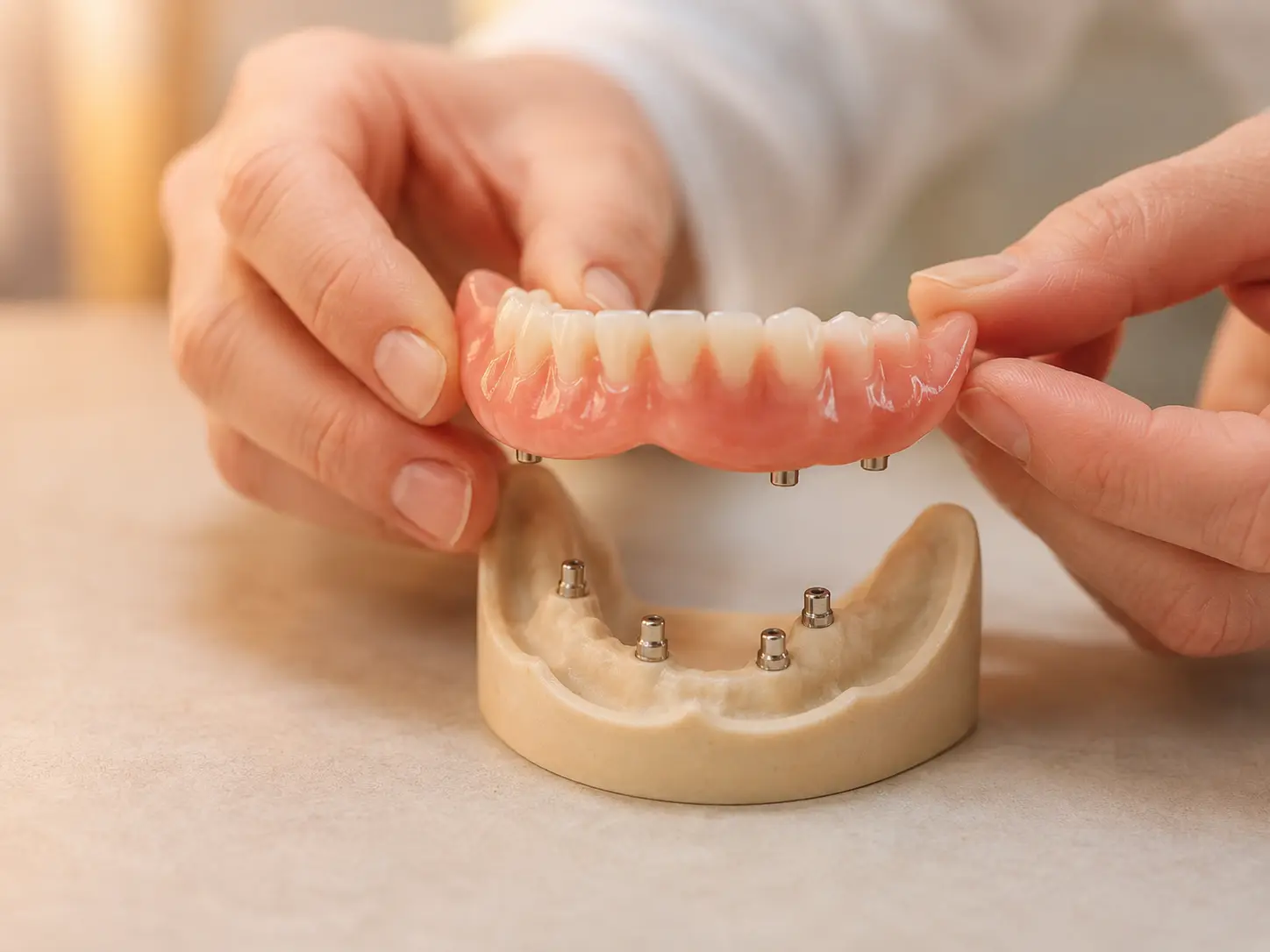
Snap-in dentures sit between two more familiar options. Conventional dentures are entirely removable and rely on suction or adhesive. Fixed full-arch implants are permanently anchored and never come out. Snap-in dentures come out like a conventional denture, but they snap onto implants for retention suction cannot provide.
The configuration is straightforward. Titanium implants are placed in the jawbone, typically two in the lower jaw and four in the upper. After osseointegration over three to six months, the implants receive attachments, most often Locator abutments, small button-shaped connectors, or a bar joining the implants. The denture carries matching fittings on its underside that snap onto those attachments. The denture comes out at night for cleaning. The implants stay in permanently.
The same procedure, several names
- Snap-in and snap-on dentures
- Implant-retained and implant-supported dentures
- Overdentures and implant-retained overdentures
Terminology varies by practice. The underlying procedure does not. The real decision points are which jaw, how many implants, and whether fixed full-arch would serve you better. The broader framework is on the comparing full-arch options page.
The part that matters most
Outcomes in the lower jaw and the upper jaw are meaningfully different. The anterior mandible has dense cortical bone, Lekholm-Zarb Type II, which gives excellent implant stability. Most of the maxilla is softer trabecular bone, Type III or IV, which is biomechanically less favourable for the lateral and rotational forces a removable overdenture transmits. Published long-term survival follows that: roughly 98% in the mandible against 91% in the maxilla.
Why the upper and lower jaw are different cases
Most marketing treats snap-in dentures as one offering: implants in either jaw, denture on top, cheaper than fixed. The clinical picture is more divided than that. Where the implants go changes predictability, longevity, and whether snap-in is the right answer at all.
Lower jaw, an established standard of care
96% to 99% survival
The McGill Consensus Statement of 2002 and the subsequent York Consensus Statement established two-implant mandibular overdentures as first-choice care for edentulous patients, which is about the broadest expert agreement available in implant dentistry. Long-term studies put implant survival in the mandible between 96% and 99%, and two anterior implants perform comparably to three or four in most cases. The dense cortical bone of the anterior mandible gives strong primary stability, and the geometry of the lower jaw transmits force favourably.
For patients with an existing or planned lower denture who want retention without the cost of fixed full-arch, this is a legitimate, well validated option.
Upper jaw, rarely the right long-term answer
91% to 92% survival
Three structural factors compromise maxillary snap-in outcomes against both mandibular snap-in and fixed full-arch.
- Bone quality is less favourable. The maxilla typically presents Type III bone, thin cortical over dense trabecular, or Type IV, thin cortical over low-density trabecular, particularly in the posterior. Published survival in Type IV bone is about 88.8% against 96% to 98% in Types I to III. The posterior maxilla resorbs after tooth loss, and the sinus pneumatises downward into the alveolar bone, reducing height and density further.
- There is no cross-arch stabilisation. Fixed full-arch distributes occlusal force across four to six implants joined by a rigid prosthesis, an engineered system that resists lateral, vertical, and rotational load. A snap-in upper denture has no splinting. Each implant carries force independently through its own attachment, and lateral force during chewing concentrates on individual implants in bone that is already compromised.
- The published outcomes confirm the concern. Long-term studies report maxillary overdenture implant survival around 91% to 92% against 96% to 99% in mandibular cases. The systematic review by Slot and colleagues found that maxillary overdentures with fewer than four implants and non-splinted Locator attachments drop further still.
What that means clinically: for most upper-jaw patients facing full-arch tooth loss, fixed full-arch implants are the recommendation that aligns with the data. Cross-arch stabilisation, four to six implants distributing load, and a rigid prosthesis address exactly the structural problems that compromise maxillary snap-in. A patient who specifically wants a removable upper prosthesis should understand the trade: measurably higher long-term failure risk in exchange for taking it out at night.
A common mistake
For patients with severe upper-jaw atrophy who are not candidates for conventional fixed full-arch, the answer is usually zygomatic implants, anchored in the cheekbone rather than the resorbed maxilla, not snap-in dentures. Many practices do not perform zygomatic protocols in house and default to recommending snap-in without raising the alternative.
When snap-in dentures make clinical sense
The indications differ by jaw. Lower-jaw indications are broad and supported by consensus statements. Upper-jaw indications are narrow, and usually reflect cases where fixed is unavailable for a specific reason.
Lower jaw, established indications
- You have an existing or planned conventional lower denture. Two-implant overdentures are first-choice care over a conventional denture alone.
- Your lower denture is unstable. The lower denture floats on a less stable foundation than the upper. Two anterior implants give secure retention and a measurable improvement in chewing function.
- You are cost-conscious with good bone in the lower anterior. Meaningfully less expensive than fixed, with high survival in favourable Type II bone.
- Hygiene dexterity is limited. A removable overdenture is easier to clean for patients with arthritis, post-stroke motor limitation, or cognitive impairment.
- Treatment horizon is shorter. For patients in their late seventies and beyond, the lifetime calculation can favour a simpler, well validated solution.
Upper jaw, limited indications
- Severe maxillary atrophy without zygomatic candidacy. Where neither conventional fixed full-arch nor zygomatic placement is feasible, the choice may be snap-in or remaining edentulous.
- Medical contraindication to longer surgery. Cardiac, pulmonary, or other conditions where minimising surgical time is clinically critical and zygomatic placement is not an option.
- A hard cost barrier with informed consent. Patients who genuinely cannot fund fixed full-arch even with financing, fully informed about the survival data.
- A clear preference for a removable upper prosthesis, for hygiene, comfort, or personal reasons, with full informed consent about the comparative outcomes.
Outside those situations, fixed full-arch is typically the recommendation for the upper jaw. If you are researching upper-jaw snap-in without one of those indications, expect the consultation to cover why the data points elsewhere.
The recommendation should follow the jaw and the imaging, not the term the patient walked in with.
— Dr. Jonathan Volland
Coordination with your Tacoma general dentist
Fixed full-arch is handled end to end at Elite. Overdenture cases are different: they are a team approach, and knowing the division of work sets expectations for timing and ongoing care.
What Elite handles
Surgical side
Pre-surgical 3D imaging and planning, surgical placement of the implants, integration over the three to six month healing period, placement of the Locator abutments or bar once integrated, and follow-up to confirm implant health.
What your dentist handles
Prosthetic side
Fabrication of the denture itself or modification of an existing one, seating the matching attachments in the denture base, occlusal adjustment, periodic relining, replacement of worn nylon inserts every six to eighteen months, and fit issues as they arise.
If you have an established dentist in Tacoma, we communicate directly with them throughout: imaging, treatment plan, surgical report, and post-operative recommendations. The implant work happens at Elite and the prosthetic work stays with your dentist. That is the standard model for overdenture care and it works well when both sides communicate clearly.
If you do not have an established dentist, we maintain working relationships with restorative practices across Pierce County and the South Sound that handle the prosthetic side. Clinical decisions such as implant number, attachment system, and positioning are made jointly between the surgical and restorative providers.
Referrals
For wisdom teeth, single implants, and surgical extractions we ask for a referral from your general dentist. For overdenture and full-arch consultations, no referral is needed.
What Tacoma patients run into
The Tacoma market is a confusing one to research this in. National chain implant centres promote the procedure hard as a lower-cost alternative to fixed full-arch. Multi-provider practices in the downtown medical district price snap-in cases variably depending on attachment system, implant count, and complexity. Local prosthodontist offices offer it as part of a broader restorative practice. Across those options the range Tacoma patients see runs roughly $5,000 to $15,000 per arch, but the underlying recommendation should be jaw-specific rather than provider-specific.
For lower-jaw cases
Two-implant mandibular overdentures are well validated and commonly performed across most full-scope oral surgery practices. Survival of 96% to 99% in long-term studies, and the McGill Consensus establishing it as a standard of care, give the recommendation real weight. The open decisions are usually attachment system, Locator against bar, implant brand, and which restorative dentist handles the prosthetic side. If you have an established dentist in Tacoma, it is worth asking whether they are comfortable managing overdenture prosthetic care. Most are, and coordination with the surgical practice is what matters.
For upper-jaw cases
Be careful about defaulting to snap-in on cost alone. Maxillary survival of 91% to 92% in long-term studies is meaningfully below the 95% and better seen with fixed full-arch, All-on-4 or All-on-6, and that gap reflects clinical and biomechanical factors that do not go away regardless of who performs the procedure. For upper-jaw cases the recommendation typically favours fixed, except in the specific situations above. For severe upper-jaw atrophy, zygomatic implants are usually the appropriate alternative rather than snap-in.
Nearby pages
In plain language
Elite is sixteen minutes east of Tacoma on SR-410, comparable to crossing town to another Tacoma neighbourhood. The consultation includes 3D imaging, which gives you anatomical data to decide on rather than whatever was advertised in a marketing brochure.
What it costs, including the long term
The upfront gap between snap-in and fixed full-arch looks large, roughly $5,000 to $10,000 against $15,000 per arch. Over a lifetime it mostly closes, because attachments wear out and dentures are consumable in a way a fixed bridge is not.
Upfront at Elite
- Lower arch, two implants — $5K to $8K
- Upper arch, four implants — $7K to $10K
- Fixed full arch, either jaw — $15,000
Snap-in figures cover surgical placement, healing abutments, attachment placement, and the denture. Pricing moves with case complexity, whether grafting is needed, and which attachment system is selected.
Ongoing maintenance
- Locator nylon inserts, every 6 to 18 months — $50 to $150
- Denture reline, every 2 to 3 years — $300 to $700
- Denture replacement, every 7 to 10 years — $1,500 to $2,500
The implants themselves typically last decades and are not replaced. The denture and its attachments are.
Run that out thirty years. A snap-in denture at $8,000 upfront, plus roughly $1,500 in attachment replacements, $2,000 in relines, and two or three denture replacements at $4,000 to $7,500, totals about $15,500 to $19,000. A fixed full arch at $15,000 upfront with maintenance lands around $15,000 to $20,000. The lifetime cost is comparable. The daily difference in function is not.
How to read that
This is not an argument against snap-in dentures. They are the right answer in specific situations, and in the lower jaw they are a standard of care. It is an argument against choosing snap-in only because it costs less, since the difference is mostly in timing rather than in total dollars. Financing terms are on the financing page, and HSA and FSA funds are eligible.
Sources for the survival data
For patients, referring dentists, and prosthodontists checking the figures above, these are the primary sources behind the survival rates, the bone-quality framework, and the standard-of-care position.
Feine JS, Carlsson GE, Awad MA, et al.
2002
The McGill Consensus Statement on Overdentures. Int J Oral Maxillofac Implants. 2002;17(4):601-2. The foundational consensus document establishing the two-implant mandibular overdenture as first-choice care for edentulous lower jaws.
Ata-Ali J, Penarrocha-Oltra D, Candel-Marti E, Penarrocha-Diago M.
2015
Long-term survival rates of implants supporting overdentures. J Oral Implantol. 2015;41(2):173-7. Prospective study of 360 implants over an average 95-month follow-up: 91.9% maxillary against 98.6% mandibular survival, statistically significant.
Slot W, Raghoebar GM, Vissink A, et al.
2014
A systematic review of implant-supported overdentures in the edentulous maxilla, compared to the mandible: how many implants? Eur J Oral Implantol. 2014;7 Suppl 2:S191-201. Maxillary survival of 88.9% to 98.1% depending on implant count and splinting.
Lekholm U, Zarb GA.
1985
Patient selection and preparation. In: Branemark PI, Zarb GA, Albrektsson T, eds. Tissue-integrated prostheses. Chicago: Quintessence; 1985:199-209. The original bone-quality classification, Types I to IV, referenced throughout the implant literature.
do Couto AS, Moraschini V, Cavalcante DM, et al.
2024
Do dental implants installed in different types of bone have different success rates? J Dent Sci. 2024;19(2):727-739. Systematic review of 49 studies and 29,905 implants: significantly lower survival in Type IV bone, 88.8%, against 96% to 98% in Types I to III.
Common questions
A conventional denture relies on suction and often adhesive. It slips while eating and speaking, needs re-setting through the day, and can stop fitting as the shape of your mouth changes. Snap-in dentures snap onto two to four implants placed in the jawbone, which gives positive mechanical retention that suction cannot match. The functional difference is substantial: the denture stays put while eating, speaking, and laughing, foods that were off the list come back, and adhesive is no longer needed. The remaining limitation compared with fixed full-arch is that it still comes out at night.
The visible difference is removability. Fixed full-arch, also called All-on-4, All-on-6, or full-mouth dental implants, is permanently anchored and brushed like natural teeth. Snap-in dentures come out at night. The difference that matters clinically is cross-arch stabilisation: fixed uses four to six implants joined by a rigid prosthesis and distributes force across the whole arch, while snap-in implants act independently through their own attachments. In the upper jaw, where bone quality is typically less favourable and lateral chewing force is higher, that absence translates into measurably lower long-term implant survival. Fixed also restores closer to 95% to 100% of natural bite force against 70% to 80% for snap-in, preserves bone better, and needs less maintenance. Upfront cost is higher, lifetime cost is comparable.
It depends substantially on which jaw. For the lower jaw, two-implant overdentures are an established standard of care with survival in the 96% to 99% range, so for a patient with an existing or planned lower denture who wants retention, it is a legitimate option; fixed in the lower jaw is also excellent, and the decision often comes down to preference and budget. For the upper jaw the recommendation is usually different: maxillary survival in overdenture cases runs 91% to 92% against 96% to 97% for fixed, the maxilla lacks the cross-arch stabilisation fixed provides, and the bone is typically Type III or IV, which is less favourable for the forces a snap-in transmits. The decision should be made at consultation after 3D imaging of your own anatomy.
The implants themselves typically last twenty years or more with appropriate care. The components above them have shorter lives. Locator nylon inserts wear out every six to eighteen months and need replacing. The denture typically needs relining every two to three years and replacing every seven to ten. A bar, in bar-retained systems, typically lasts fifteen to twenty years or more. That ongoing maintenance is one of the practical disadvantages against fixed full-arch, where components are not replaced on the same interval, and it belongs in the lifetime cost calculation.
Placement is performed under IV sedation, so you are asleep and will not remember it, and local anaesthetic is given after sedation begins so the site is fully numb. Post-operative discomfort is similar to other implant procedures: mild to moderate swelling and tenderness for three to seven days, managed with prescribed medication. Once healed, the denture itself should not be painful. The first two to four weeks usually involve some adjustment as the gums adapt to a new pressure distribution, but persistent pain after that points to a fit issue that needs adjusting rather than something to tolerate.
Sometimes, depending on the original configuration. If two implants were placed for a lower snap-in, converting to fixed typically means placing two to four more. If four were placed for an upper snap-in, those same four may be reusable for fixed depending on their positioning. This is worth raising at the initial decision point: if a later upgrade is plausible, the snap-in configuration can be planned with that conversion in mind, which makes the eventual transition simpler.
Heading 1
Heading 2
Heading 3
Heading 4
Heading 5
Heading 6
Lorem ipsum dolor sit amet, consectetur adipiscing elit, sed do eiusmod tempor incididunt ut labore et dolore magna aliqua. Ut enim ad minim veniam, quis nostrud exercitation ullamco laboris nisi ut aliquip ex ea commodo consequat. Duis aute irure dolor in reprehenderit in voluptate velit esse cillum dolore eu fugiat nulla pariatur.
Block quote
Ordered list
- Item 1
- Item 2
- Item 3
Unordered list
- Item A
- Item B
- Item C
Bold text
Emphasis
Superscript
Subscript
A jaw-specific answer, grounded in the published data.
The consultation includes 3D imaging and an honest read of what the outcome data shows for your case. A two-implant lower overdenture coordinated with your Seattle dentist may be exactly right. For the upper jaw, fixed full-arch is more often the appropriate recommendation. The drive south is 30 to 45 minutes.